Altitude whispers: how elevation levels have quietly redirected scoring frequencies and tactical adjustments in baseball, soccer, and football contests across varying global venues
Nils Bennett · Jun 13, 2026
Altitude whispers: how elevation levels have quietly redirected scoring frequencies and tactical adjustments in baseball, soccer, and football contests across varying global venues
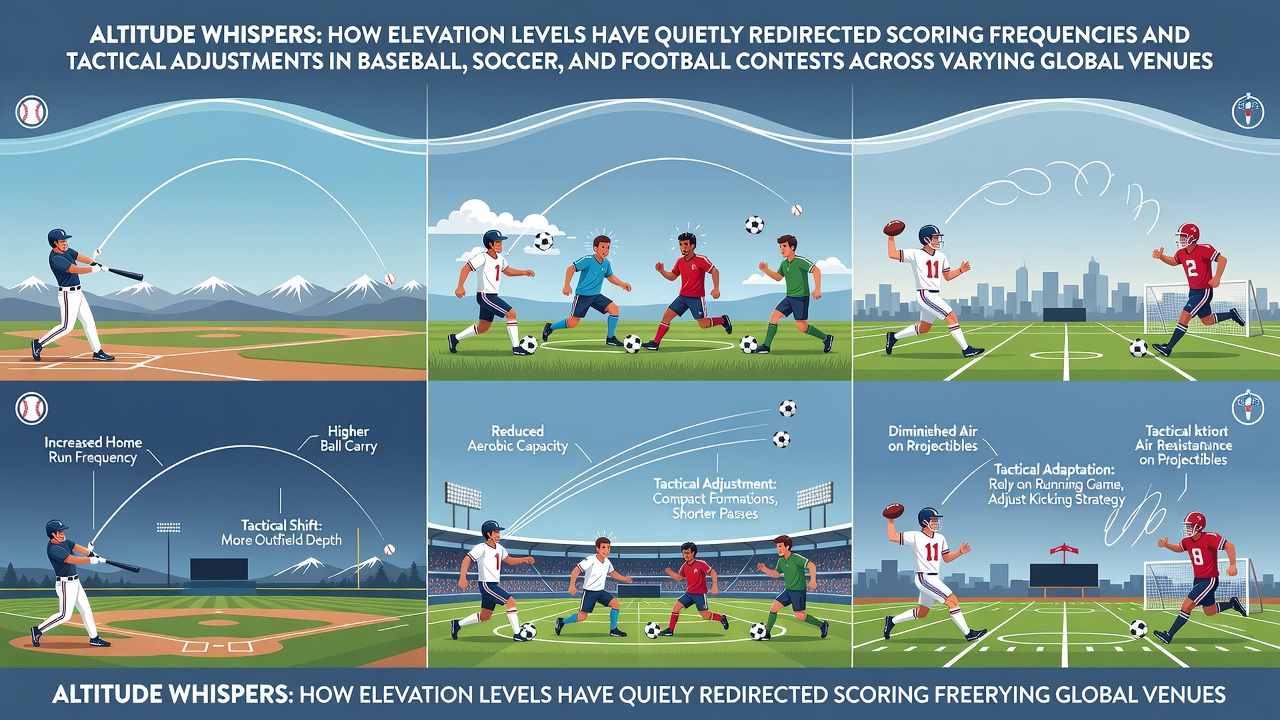
High elevation venues have reshaped performance patterns in multiple sports because reduced air density alters ball flight paths and oxygen availability for athletes. Data from stadiums at different heights shows measurable shifts in scoring rates and strategic decisions that teams implement to adapt. Venues such as Denver's Coors Field sit at roughly 5,280 feet while La Paz reaches over 11,800 feet and these differences create distinct conditions that influence outcomes across baseball, soccer, and American football matches played there.
Baseball scoring patterns at elevated sites
Coors Field records higher home run totals than sea-level parks because the thinner atmosphere allows batted balls to travel farther on average. Historical MLB statistics indicate that teams playing in Denver produce more extra-base hits per game compared with lower-elevation counterparts while pitchers adjust by relying on breaking pitches that behave differently in the reduced drag environment. Researchers from the University of Colorado have documented these effects through trajectory modeling that accounts for altitude-specific variables and the patterns hold steady across multiple seasons.
Teams visiting high-altitude parks often modify their roster selections and bullpen usage to account for increased offensive output. Pitchers with strong ground-ball tendencies see more frequent deployment because fly balls become riskier propositions when the air offers less resistance. Catchers and infielders adapt positioning slightly to handle the altered bounce adn carry of balls hit into the outfield gaps.
Soccer dynamics in thin-air environments
Stadiums in Bolivia and parts of the Andes demonstrate how elevation influences soccer match statistics with faster ball speeds recorded on passes and shots yet quicker player fatigue setting in during the second half. CONMEBOL match logs reveal elevated goal tallies in certain highland fixtures although possession retention rates drop as oxygen uptake declines for players unaccustomed to the conditions. Training protocols for visiting clubs now incorporate pre-match acclimatization periods that last several days to mitigate performance drops.

Coaches shift formations toward more compact defensive structures early in games to conserve energy while exploiting the longer range that passes achieve in thinner air. Substitution patterns change as well with more frequent changes at the wing positions where repeated sprints become taxing. FIFA technical reports note these adjustments appear consistently in international qualifiers held above 8,000 feet.
Football venue adaptations and play calling
American football contests at elevated locations such as those hosted by the Denver Broncos exhibit increased passing yardage averages because quarterbacks benefit from reduced air resistance on deep throws. NFL play-by-play data collected over two decades shows a modest rise in completion percentages for vertical routes while running plays maintain steadier production levels because ground-based elements remain less affected. Defensive schemes emphasize coverage adjustments to account for the extended flight time of passes.
Special teams units modify kick strategies with punters aiming for higher trajectories that gain extra distance and placekickers calibrating approach angles to compensate for the altered trajectory. Training camps held at altitude prepare players through repeated exposure sessions that improve red blood cell counts and delay the onset of fatigue during game situations.
Global venue comparisons and data trends
Studies compiled by the Australian Institute of Sport compare performance metrics across continents and highlight how venues in South Africa and Mexico produce similar directional changes in scoring frequencies when elevation exceeds 4,000 feet. These patterns emerge in both summer baseball schedules and winter soccer leagues because the physical principles of air density remain constant regardless of season. Observers tracking June 2026 fixtures note that upcoming international tournaments scheduled at mixed-elevation sites continue to prompt teams to finalize acclimatization plans months in advance.
Equipment choices also reflect altitude considerations with baseballs stored in humidity-controlled environments at high parks to maintain consistent weight and soccer balls selected for their seam patterns that influence drag coefficients. American footballs undergo similar preparation though the leather casing responds less dramatically to the thinner atmosphere.
Conclusion
Elevation continues to steer tactical choices and scoring distributions in baseball, soccer, and football through its effects on ball behavior and athlete physiology. Venues worldwide supply ongoing datasets that organizations use to refine preparation methods and rule considerations remain stable while teams focus on practical adjustments that maximize results under specific atmospheric conditions.