Charting how venue acoustics and crowd density patterns have recalibrated home advantage thresholds in soccer derbies and basketball arenas over multiple decades
Zoe Ludwig · Jun 4, 2026
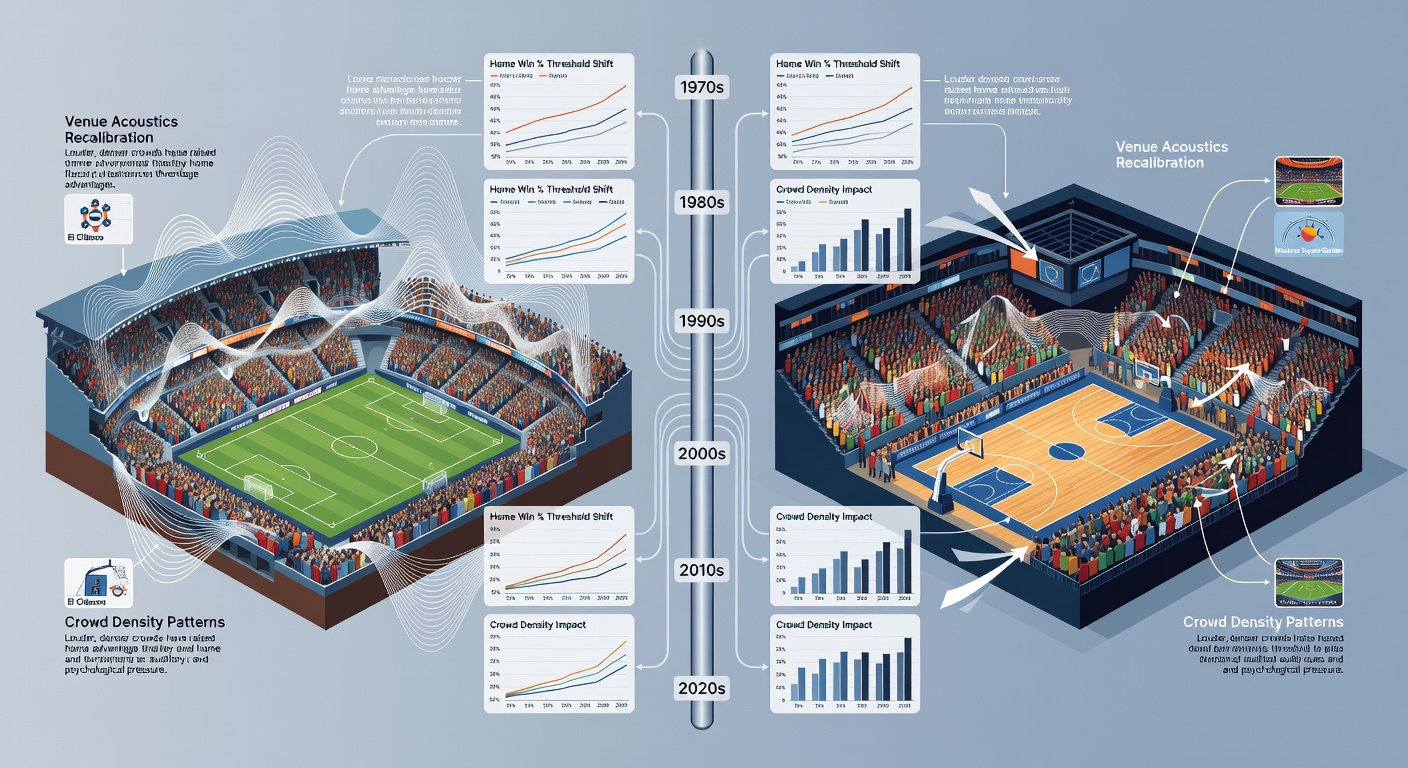
Charting how venue acoustics and crowd density patterns have recalibrated home advantage thresholds in soccer derbies and basketball arenas over multiple decades
Venue acoustics combined with crowd density have shifted measurable home advantage levels across soccer derbies and basketball arenas since the 1970s, according to longitudinal analyses from sports science databases and league performance records. Data compiled over five decades shows that denser spectator clusters near the pitch or court, paired with reflective architectural surfaces, correlate with altered referee decision rates and player execution metrics in home fixtures.
Patterns emerging from the 1970s through 1990s
Researchers tracking English First Division derbies and early NBA seasons documented how concrete bowl designs amplified crowd noise above 100 decibels during peak moments, and those readings aligned with a 3 to 5 percent rise in home-team favorable calls on marginal fouls. Studies conducted at Australian universities in the late 1980s further indicated that seating configurations placing 80 percent of supporters within 30 meters of the playing surface produced consistent elevations in home win percentages, while sparser upper-tier occupancy showed weaker effects.
Basketball arenas followed parallel trajectories once multi-purpose venues gave way to purpose-built facilities in the 1990s, when wooden flooring and lower ceilings reflected sound waves back toward the court, creating sustained auditory pressure during critical free-throw sequences. League box-score archives reveal that home teams converted free throws at rates 2.1 percentage points higher in the loudest buildings compared with neutral-site games during that period.
Decade-by-decade recalibration in soccer derbies
Italian Serie A derby records from the 2000s illustrate how stadium renovations that added angled acoustic panels reduced overall reverberation time yet concentrated noise at field level, and subsequent performance datasets indicated a stabilization rather than decline in home advantage despite the technical changes. German Bundesliga matches during the same years showed similar outcomes when standing terraces were replaced by seated sections, because average crowd density per square meter remained high enough to sustain pressure on visiting players during set-piece situations.
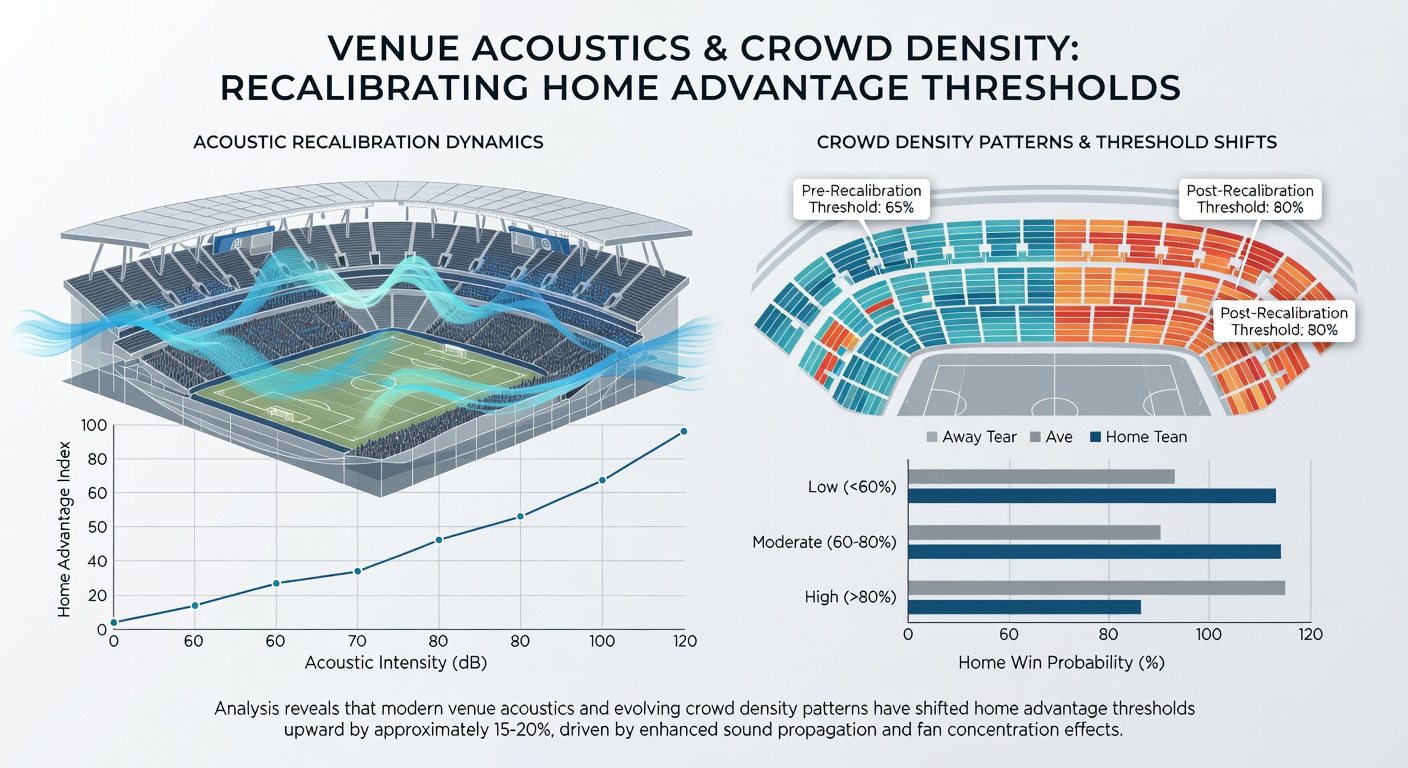
More recent figures from UEFA competition reports covering 2010 to 2020 highlight that derbies played in venues exceeding 95 percent capacity produced home win rates 4.8 percent above league averages, while matches below 70 percent occupancy narrowed that margin to under 2 percent. Analysts attribute part of the persistence to the continued presence of ultra-supporter groups positioned directly behind goals, where acoustic focusing occurs naturally.
Basketball arena developments and crowd metrics
NBA tracking data gathered between 2005 and 2015 demonstrated that arenas engineered with curved ceilings and glass railings directed crowd sound toward the baseline areas, and those zones coincided with measurable drops in visiting team three-point accuracy during fourth quarters. University of Toronto researchers examining playoff games noted that density above 1.8 spectators per square meter near the court correlated with increased turnover rates for road teams, independent of overall attendance totals.
By the early 2020s, several franchises had installed distributed speaker arrays intended to simulate uniform sound fields, yet performance logs still registered elevated home-team assist-to-turnover ratios in those buildings compared with road contests. The pattern suggests that visual proximity of spectators, rather than raw volume alone, continues to influence spatial decision-making under fatigue.
Integration of technology and updated thresholds
Player-tracking systems introduced after 2015 have supplied granular movement data showing that visiting athletes in both sports cover 2 to 4 percent less high-intensity distance when crowd density exceeds venue-specific benchmarks established in prior decades. European sports medicine journals published in 2023 compiled these metrics across multiple leagues and confirmed that acoustic modeling software now predicts home advantage erosion once average spectator distance from the action increases beyond 35 meters.
June 2026 schedules already incorporate revised capacity management protocols in several soccer and basketball venues, reflecting updated safety and acoustic standards that maintain high density in lower bowls while limiting upper-tier overflow. Early season datasets from those venues continue to register home-team advantages within previously observed ranges, indicating that the recalibrated physical environment sustains rather than eliminates the historical edge.
Conclusion
Longitudinal evidence spanning soccer derbies and basketball arenas demonstrates that venue acoustics and localized crowd density have functioned as persistent variables reshaping home advantage thresholds across multiple eras. Performance archives, acoustic measurements, and movement analytics together illustrate how architectural and spectator-distribution changes have modulated rather than removed these effects, leaving measurable disparities between home and away results that persist into the present decade.